


Zero Emission Vehicles

The Scottish Wholesale Association is leading efforts to reduce transport emissions and support members in adopting cleaner, greener logistics solutions.

Zero Emissions Vehicles Scottish Wholesale Association Driving Sustainability
Zero-Emission-Vehicles-SWAZero-Emission-Vehicles-SWAWatermark 'V' enters from rightWatermark 'V' enters from left
'WM' watermark'WM' watermark

Zero Emissions Vehicles

The Scottish Wholesale Association is leading efforts to reduce transport emissions and support members in adopting cleaner, greener logistics solutions.

Zero Emissions Vehicles Scottish Wholesale Association Driving Sustainability
Zero-Emission-Vehicles-SWAZero-Emission-Vehicles-SWAWatermark 'V' enters from rightWatermark 'V' enters from left
'WM' watermark'WM' watermark

We Are Removing Barriers to Achieving Net Zero Vehicle Emissions

Heavy Goods Vehicles (HGVs) are the biggest source of operational carbon emissions in the food and drink wholesale sector. In order to achieve Net Zero, a transition to zero emission vehicles will be needed.

The Scottish Wholesale Association is working to remove barriers to this transition, collaborating with a wide range of partners, and providing our members with opportunities to trial and implement change.

Reduce emissions from your fleets

While the transition to zero emission vehicles is in its early stages, there are still actions you can take now to reduce your environmental impact from transport.
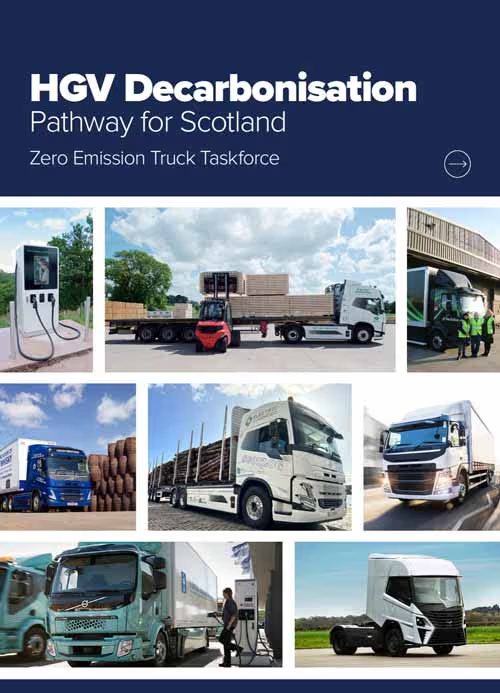
HGV-Decarbonisation-Pathway-for-Scotland-SWA

Download the HGV Decarbonisation Pathway for Scotland.

SWA, together with other leading actors, has developed a suite of actions to decarbonise Scotland’s HGV industry.

Introduce route optimisation

  • Route optimisation plays a crucial role in reducing emissions from HGVs by increasing the efficiency of the existing fleet.
  • Using advanced algorithms and real-time data, it can significantly reduce fuel consumption.
  • Efficient route planning minimises the distance travelled and avoids congested areas, leading to lower fuel usage and reduced idling times.

Test and plan for the switch to electric vehicles

  • Introducing electric cars and HGVs will be essential for the sector to meet Net Zero goals, as these vehicles produce zero tailpipe emissions.
  • With the UK Government banning the sale of new diesel and petrol cars and vans by 2030 and HGVs by 2040, it is important to plan for the change that is coming.

Switch to lower carbon refrigeration on HGVs

  • The switch to lower carbon refrigeration on HGVs is an important move towards reducing the environmental impact of transport fleets.
  • Traditional refrigeration systems often use fluorinated gases, or F-gases, mainly in the form of hydrofluorocarbons (HFCs), which are potent greenhouse gases.
  • By transitioning to low global warming potential (GWP) alternatives such as hydrocarbons, carbon dioxide, or electric-powered systems, the environmental footprint can be significantly reduced.

Member Support Service

SWA member 'Optimize' is an AI route optimisation specialist company that helps fleets reduce costs, increase productivity and cut emissions.

SWA members are eligible for a free initial benchmarking service and receive a 10% discount.

Find out more here with our Customer Welcome Pack

Contact: Fred Bell, fred.bell@optimizenow.ai
 

Net Zero Priorities

APPLY HERE FOR MEMBERSHIP